

Oct . 08, 2025 22:30 Back to list
Bentazone Herbicide: Fast, Selective Weed Control—Why?
Bentazone 480g/L SL China Herbicide: Field Notes, Lab Data, and What Buyers Really Ask
If you work in beans, peas, or rice, you’ve probably had a love–hate relationship with broadleaf weeds and sedges. I’ve seen co-ops grapple with this every spring. That’s why I’ve been watching bentazone herbicide formulations closely—especially the modern 480 g/L SLs coming out of North China’s manufacturing belt. The short version: post-emergence contact control, minimal soil residual, and—when timed right—clean rows without bruising the crop.
Industry trend: precise post-emergence, cleaner labels
Across APAC and LATAM, distributors tell me demand is shifting toward contact herbicides like bentazone herbicide that keep residues low and tank-mix neatly with grass partners. Actually, the biggest surprise is how many growers now request jar-test screenshots before they buy—compatibility and water quality are a big deal on-farm.
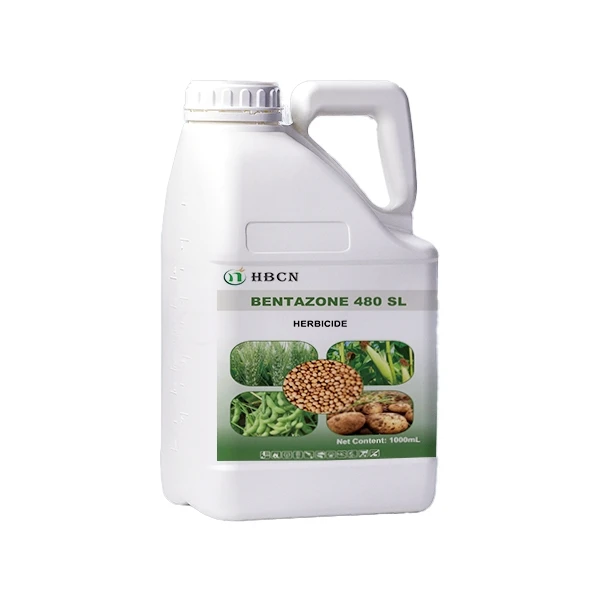
Product snapshot: Bentazone 480g/L SL (CNAGROCHEM, Hebei, China)
Origin: No.1810 Tower B, Jinyuan Building, 152 Huai'an Road, Yuhua District, Shijiazhuang City, Hebei, China. Description: Bentazone SL Crop Protection Product for post-emergence broadleaf and sedge control in soybeans, peanuts, peas, and rice.
| Active ingredient | Bentazone ≈ 480 g/L (SL) |
| Assay (typical QC) | 480 ± 10 g/L (CIPAC a.i. method) [1] |
| pH (25°C) | ≈ 8.0 (CIPAC MT 75), real-world water may shift ±0.5 |
| Density | ≈ 1.15 g/mL at 20°C |
| Stability | Pass 0°C/54°C accelerated (14 d) per CIPAC MT 39/46 [1] |
| Shelf life | ≈ 2 years sealed, away from heat/frost |
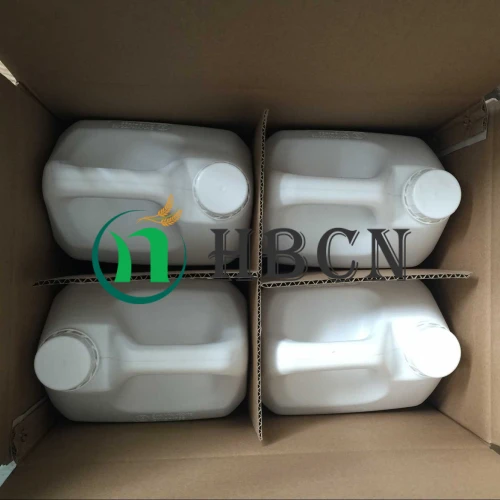
| Packaging | 1L, 5L, 20L HDPE; multilingual labels |
How it’s made and tested (short version)
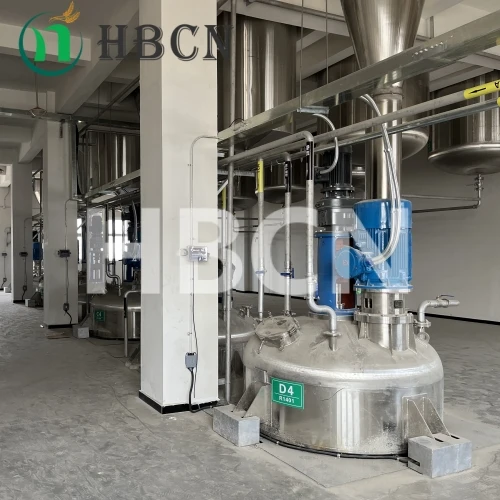
Materials: technical bentazone (≈95% TC), water, pH modifiers, wetting agents. Methods: high-shear dissolution, pH balancing, filtration to sub-100 μm, inline conductivity checks. Testing: a.i. content by CIPAC, pH (MT 75), cold/heat stability (MT 39), storage stability at 54°C, and jar-test with local water samples. Certifications: ISO 9001 QMS; SDS and GHS labels available. To be honest, most buyers want batch COAs plus a retained-sample policy—both are standard here.
Use scenarios and tips
- Soybean/peanut/peas: post-emergence on small weeds (2–6 leaf) for Amaranthus, Chenopodium, and sedges; typical rate 0.48–1.0 kg a.i./ha, water 200–400 L/ha. Always follow local label.
- Rice: useful on sedges in dry-seeded or paddy; avoid crop stress days—this is a contact herbicide.
- Tank-mix: often paired with grass partners (e.g., quizalofop). Always do a jar test with your water source.
- Rainfastness: around 6 hours, but label rules first.
Advantages many customers cite: fast scorch on broadleaves, low soil carryover, and a forgiving SL that rinses clean. However, coverage is everything—flat-fan nozzles and medium droplets tend to shine.
Vendor comparison (what buyers benchmark)
| Vendor | Registration support | MOQ | Lead time | Certs |
|---|---|---|---|---|
| CNAGROCHEM (Hebei) | Dossier pack (CIPAC/FAO data), samples, COAs | ≈ 3,000–5,000 L | 15–25 days ex-works | ISO 9001; SDS/GHS |
| Regional Trader A | Basic COA only | ≈ 1,000 L | 30–40 days | Supplier-declared |
| OEM Blender B | Private label only | Custom | Varies | On request |
Customization and service life
Custom options: label languages, bottle colors, induction seals, and UN-rated cartons for export. Service life is about two seasons sealed; once opened, keep caps tight and avoid freezing—real-world use may vary.
Case notes from the field
- Soybean co-op, Paraná: early POST + grass partner, ≈85–90% broadleaf/sedge control at 21 DAT; zero observed crop stunting under mild conditions (internal trial notes; agronomist-supervised).
- Rice scheme, Mekong Delta: improved yellow nutsedge knockdown on 3–5 leaf stage; growers liked the “see-it-next-day” contact effect. I guess speed matters on busy spray weeks.
Compliance touchpoints: follow national labels and MRL frameworks (Codex/US EPA/EFSA). For specs, I lean on FAO/WHO and CIPAC—keeps procurement disciplined and testable.
References:
- FAO/WHO Specifications & Evaluations for Bentazone; CIPAC methods referenced.
- US EPA, Bentazon Reregistration Eligibility Decision (RED), Office of Pesticide Programs.
- EFSA Journal: Conclusion on the peer review of the pesticide risk assessment of the active substance bentazone.
- University extension weed control guides (e.g., NDSU/Arkansas) for POST timing and tank-mix guidance.
-
Imidacloprid Olefin – High-Performance Agricultural Pest Control Solutions from CN Agrochemical
NewsDec.09,2025
-
Comprehensive Guide to Imidacloprid Msds - Safe & Effective Pest Control Solutions from CN Agrochem
NewsDec.09,2025
-
Comprehensive Overview of Imidacloprid Mosquito Control for B2B Decision Makers
NewsDec.09,2025
-
Imidacloprid Mosquito: Effective & Sustainable Mosquito Control Solutions for B2B
NewsDec.09,2025
-
Effective Imidacloprid Mite Control for Industrial Agriculture
NewsDec.08,2025
-
Understanding Imidacloprid Mexico: Applications, Benefits & Environmental Impact
NewsDec.08,2025