

Oct . 14, 2025 08:05 Back to list
Bentazone Herbicide: Fast, Selective Post-emergence Control
Bentazone 480g/L SL: field notes, specs, and what growers are actually seeing
When people ask me which post-emergence product still earns its keep in soybeans, rice, and peanuts, I often point to bentazone herbicide. It’s an old hand with a modern resume. Contact activity, quick scorch on broadleaves and sedges, and—crucially—selectivity that many growers quietly appreciate. To be honest, it’s not flashy, but it’s reliable.
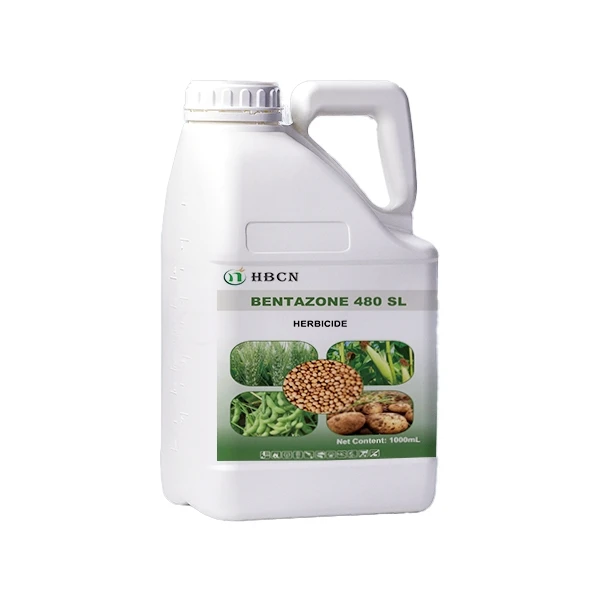
What’s inside the can
Product: Bentazone 480g/L SL China herbicide (Bentazone SL Crop Protection Products). Origin: No.1810 Tower B, Jinyuan Building, 152 Huai'an Road, Yuhua District, Shijiazhuang City, Hebei Province, China. Mode of action: PSII inhibitor at the QB site (HRAC/WSSA Group 6). Real-world take: fast burn-down on small weeds; minimal soil residual, which some agronomists like for rotation flexibility.
| Parameter | Spec (≈/typical) |
|---|---|
| Active ingredient | Bentazone 480 g/L (SL) |
| Density (20°C) | ≈1.15 g/mL |
| pH | 7–9 (real-world batches may vary) |
| Formulation aids | Water-based solvents, co-solvents, surfactant system |
| Crops | Soybean, rice, peanut, pea, beans; local labels prevail |
| Target weeds | Broadleaf weeds, sedges (e.g., yellow nutsedge when small) |
| Shelf life | 2 years unopened at 0–35°C |
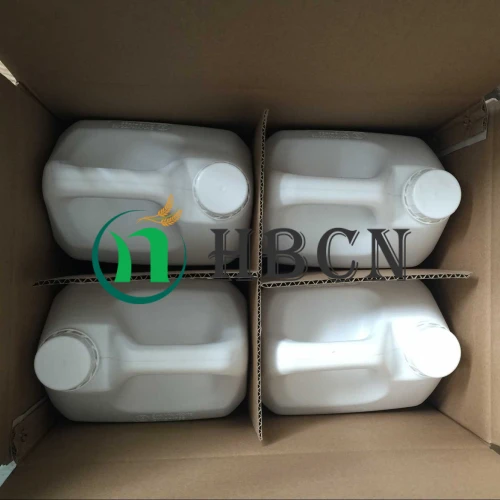
| Packaging | Customized: 1L, 5L, 20L HDPE; private label available |
How it’s made and tested
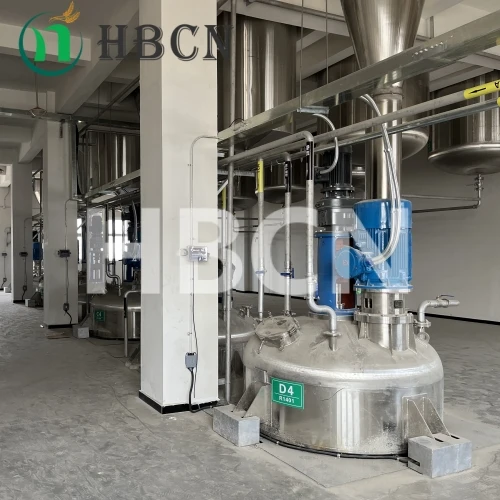
Materials: technical bentazone (≈95% TC), deionized water, co-solvents, nonionic/anionic surfactants, defoamer. Method: dissolve TC, blend surfactant package, pH adjust, inline filtration (5–10 μm), QC, and cleanroom filling. Testing: a.i. assay by HPLC per CIPAC guidance; pH (CIPAC MT 46); stability (accelerated 54°C/14 days, CIPAC MT 39); cold test -5°C/7 days; emulsion/miscibility checks for spray-tank compatibility. Certificates often include ISO 9001/14001/45001; many batches are produced under GLP-aligned QC procedures.
Field use, rates, and what to expect
- Typical rate: 0.7–1.2 L/ha of 480 g/L SL; adjust for weed species and size (always follow your local label).
- Water volume: 200–400 L/ha; good coverage matters because it’s contact-acting.
- Adjuvants: many labels recommend a nonionic surfactant for tougher sedges.
- Service life in field: foliar contact activity, limited residual; rotation-friendly.
- Efficacy data (indicative): 80–95% control on small broadleaves; 70–85% on small sedges; declines sharply on oversized weeds.
Customer feedback? Many growers say they like the “see-it-next-day” burn and the way it sits in a program with ALS or HPPD partners without awkward carryover. Drift caution still applies—tender crops can show spotting.
Where it fits in 2025 programs
With resistance pressure rising, bentazone herbicide earns a slot as a non-ALS, non-HPPD, non-glyphosate contact option. I’ve seen it used as a directed spray in row middles in rice, and as a post in soybean mixes to widen the spectrum. It’s not a silver bullet—but it’s a very useful wrench in the toolbox.
Vendor landscape and customization
From China, the producer behind this SKU offers OEM labeling, adjuvant tweaks, and packaging tailored to importer regs. Actually, the flexibility is the draw—small MOQs for pilot launches are feasible, which, surprisingly, some EU distributors told me is rare.
| Vendor | Strengths | Limits/Notes |
|---|---|---|
| CN Producer (Hebei) | Competitive pricing, private label, ISO-certified, fast lead times | Shipping timelines fluctuate around peak seasons |
| EU Formulator | Strong stewardship, multilingual labels | Higher price; MOQ can be strict |
| Regional Trader | Local stock, flexible delivery | Specs may vary by batch; check COA closely |
Case notes
Peanut farm, humid subtropics: post-app at 0.9 L/ha on 2–4 leaf broadleaves gave ≈92% control; added NIS improved sedge hit by ~8%. Soybean strip trial: mix with a PPO partner delivered cleaner rows for 3–4 weeks; no notable crop injury at labeled timing. Not scientific gospel, but consistent with trial reports I’ve read.
Safety, stewardship, and compliance
bentazone herbicide is a Group 6 PSII inhibitor—rotate modes of action. Observe buffer zones near sensitive crops and water. Follow FAO/WHO specs and national labels; many importers request GLP residue data and OECD phys-chem dossiers. As always, PPE and nozzle selection matter more than marketing claims.
Citations
- HRAC Classification: Photosystem II inhibitors, Group 6 (QB site). https://hracglobal.com
- FAO/WHO Pesticide Specifications & CIPAC methods for bentazone (SL). https://www.fao.org/agriculture/crops/thematic-sitemap/theme/pests/pm/en/
- US EPA Bentazon Reregistration documents (mode of action, use patterns). https://www.epa.gov
-
Imidacloprid Olefin – High-Performance Agricultural Pest Control Solutions from CN Agrochemical
NewsDec.09,2025
-
Comprehensive Guide to Imidacloprid Msds - Safe & Effective Pest Control Solutions from CN Agrochem
NewsDec.09,2025
-
Comprehensive Overview of Imidacloprid Mosquito Control for B2B Decision Makers
NewsDec.09,2025
-
Imidacloprid Mosquito: Effective & Sustainable Mosquito Control Solutions for B2B
NewsDec.09,2025
-
Effective Imidacloprid Mite Control for Industrial Agriculture
NewsDec.08,2025
-
Understanding Imidacloprid Mexico: Applications, Benefits & Environmental Impact
NewsDec.08,2025